Lead Reporting
Measuring lead generation quality
Define enquiry stages, compare acceptance and cost, and follow customer outcomes without treating every submission as a qualified lead.
Measure lead generation quality by tracking genuine enquiries through assessment, sales acceptance and customer outcomes. Submission volume only shows how many requests arrived. It cannot show whether sales could act on them or whether they led to work.
Give each stage a clear meaning
| Stage | Count when | Keep distinct from |
|---|---|---|
| Enquiry received | A request reaches the business through a recognised route | Page views, clicks and failed forms |
| Enquiry assessed | The request is checked against agreed criteria | Automatic form completion |
| Accepted for sales follow-up | Sales agrees it can take a useful next action | Assigning a record to a queue |
| Opportunity | Potential work is recorded under the team's opportunity rule | A conversation with no defined opportunity |
| Customer | A verified customer milestone occurs | A proposal or open deal |
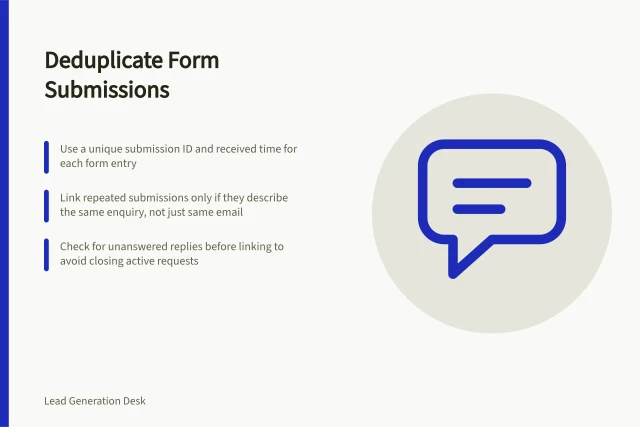
These are proposed reporting definitions, not universal CRM settings. Decide whether downloads, support requests and repeated submissions belong in the enquiry total. Show requests awaiting assessment separately. Date any counting-rule change so a shift in the reported rate is not mistaken for a quality change.
If using analytics events to track lead stages, treat them as a complementary view rather than a count of distinct enquiry requests. Use enquiry records for request-level decisions.
Lead Generation Quality Measurement Stages
- Enquiry receivedA request reaches the business through a recognised route
- Enquiry assessedThe request is checked against agreed criteria
- Accepted for sales follow-upSales agrees it can take a useful next action
- OpportunityPotential work is recorded under the team's opportunity rule
- CustomerA verified customer milestone occurs
Record the decision behind the number
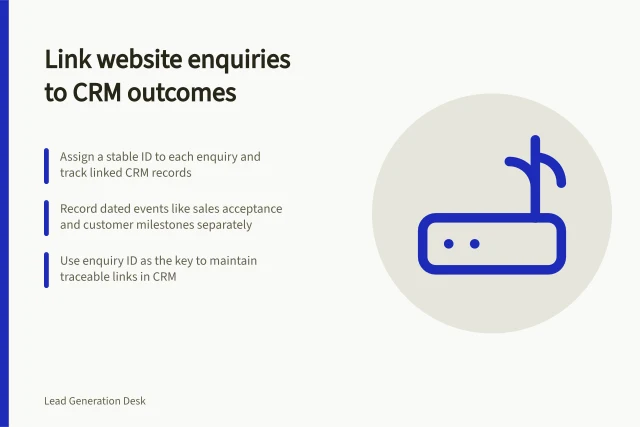
For each genuine enquiry, retain an identifier, received date, requested service, known source, owner and assessment outcome. Record a short reason for the outcome, such as service fit, insufficient detail or work outside scope. Leave an unclear request awaiting clarification instead of forcing a decision.
Defining the qualification rule before a campaign is a separate task; this measurement uses the decision actually recorded.
Essential Data to Record for Each Enquiry
- Identifier
- Unique reference for tracking
- Received date
- When the request was received
- Requested service
- Service or product inquired about
- Known source
- Channel or campaign origin
- Assessment outcome
- Service fit, insufficient detail, out of scope
Read the measures together
For a defined received-enquiry cohort, show the counts behind each measure:
- Acceptance rate:accepted enquiries divided by assessed genuine enquiries.
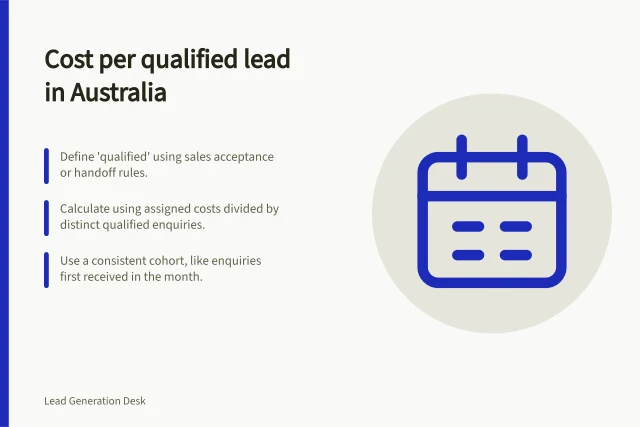
- Cost per qualified lead:assigned lead-generation cost divided by distinct enquiries meeting a stated qualification rule.
- Enquiry-to-customer rate:enquiries in the cohort linked to a verified customer milestone divided by eligible enquiries in that cohort.
State whether “qualified” means marketing-qualified or accepted by sales. Keep pending assessments visible beside the rate. A recently received cohort has had less time to produce customers than an older one.
Choose a consistent cost boundary and state the period and currency. Keep the unit consistent: requests, organisations, opportunities and new customers are different measures.
A platform conversion count checks configured actions; it does not independently establish service fit or revenue. Reconcile a sample with the enquiry and sales records before using it to direct spend. Follow Google Analytics' best practices for avoiding personally identifiable information when using the platform.
Key Lead Quality Metrics and Definitions
- Acceptance rate
- Accepted enquiries ÷ assessed genuine enquiries
- Cost per qualified lead
- Assigned lead-gen cost ÷ distinct qualified enquiries
- Enquiry-to-customer rate
- Enquiries linked to verified customer milestone ÷ eligible enquiries
Using Platform Conversion Events vs. Enquiry Records
- Pros of platform conversion events
- Automated tracking of configured actions; useful for real-time monitoring
- Cons of platform conversion events
- Does not verify service fit or revenue; risk of misattribution without reconciliation
- Pros of enquiry records
- Supports decision-making with context; enables audit trail and compliance with ATO standards
- Cons of enquiry records
- Requires manual input and governance; may delay reporting
Use the review to choose a response
Ask which sources produced actionable requests, where cases stalled before acceptance and which older cohorts produced customers. Read the recorded reasons before changing a campaign. A lower acceptance rate could reflect a changed offer, a stricter rule or unassessed requests.
In this guide
- Lead volume versus accepted sales enquiriesCompare incoming lead counts with the enquiries sales accepts, using clear denominators and a visible assessment backlog.
- Calculating cost per qualified leadCalculate cost per qualified lead with a defined cost boundary, qualification rule and enquiry cohort, then read the result in context.
- Tracking enquiries that become customersLink enquiry records to verified customer milestones and compare cohorts without confusing open deals with completed sales.