Lead Reporting
Part of Measuring lead generation quality
Tracking enquiries that become customers
Link enquiry records to verified customer milestones and compare cohorts without confusing open deals with completed sales.
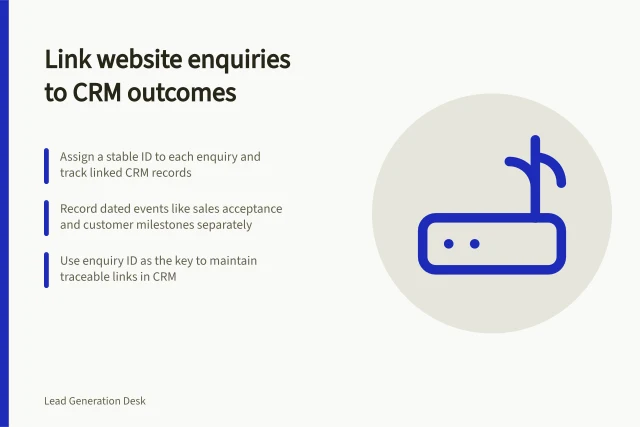
Track enquiries that become customers by giving each genuine request a stable record. Preserve its received date and known source, then link it to a verified customer milestone. Report outcomes for a defined received-enquiry cohort as at a stated review date. A customer recorded this month may have first enquired months earlier.
Decide what “became a customer” means
Choose a milestone the business can verify, such as a signed agreement or first completed purchase, and record its date. An accepted enquiry, meeting, open opportunity or proposal is not that milestone. Keep renewals and repeat purchases separate from first-time customer acquisition when reporting new customers.
Decide which unit the rate follows. One person may submit twice about the same project; one organisation may have several projects; one enquiry may lead to several deals. For a new-customer acquisition rate, link each new customer to at most one originating enquiry under a documented rule. Preserve other related enquiries in the record without counting the same new customer repeatedly.
A useful record contains the enquiry ID, received date, requested service, known original source, assessment status, linked opportunity or deal ID, customer milestone and milestone date. Mark missing source or outcome information as unknown. Retain the dated changes needed to reconstruct the path rather than relying only on the CRM's current stage.
Steps to Track Enquiries That Become Customers
- Define a verifiable customer milestone (e.g., signed agreement or first purchase)Ensure milestone is consistently applied across records
- Assign each new customer to one originating enquiry using a documented ruleAvoid double-counting repeat purchases or multiple submissions
- Record key data: enquiry ID, received date, source, linked deal, milestone dateMark missing information as 'unknown' and retain historical changes
Follow a received-enquiry cohort
Suppose a hypothetical cohort contains 40 genuine enquiries received in April. By the end of September, 20 have been accepted for sales follow-up and four distinct new customers have reached the chosen milestone, each assigned to one enquiry in the cohort.
The observed enquiry-to-customer rate is 4 ÷ 40 = 10%. The accepted-enquiry-to-customer rate is 4 ÷ 20 = 20%. They answer different questions.
A September cohort has had less time for follow-up than an April cohort. Show open opportunities, pending assessments and unresolved record matches beside the customer count. Update older cohorts as their outcomes mature while keeping their original received period. If the report uses a fixed observation window, state it and label later outcomes separately.
Check the link before trusting the rate
Trace a sample from the original request to the verified milestone. Check repeated forms, merged contacts, existing-customer enquiries and deals without a reliable originating request. An organisation's later purchase does not prove that every earlier enquiry from it generated that customer.
HubSpot's default lifecycle stages distinguish a sales-qualified lead, an opportunity associated with a deal and a customer with at least one closed deal. Organisations can customise those stages. The Customer label alone does not establish that a record meets this report's chosen milestone; check the linked deal and outcome before counting it.
GA4 documentation covers recommended events and a lead acquisition report. The specifics depend on how the property is configured, so check the platform's definitions before comparing them with a request-level received-enquiry cohort.
Reconcile any analytics or ad-platform outcome with the business record. Do not send names, email addresses or unfiltered enquiry text that may contain personal information to GA4.
Verification Checklist Before Reporting Rates
- Trace sample from original request to verified customer milestoneConfirm no merged contacts or duplicate submissions
- Verify linked deal and closed outcome before counting as customerCustomer label alone is not sufficient
Describe the result accurately
Report the cohort, review date, verified new customers and unresolved cases. A recorded source can help compare where enquiries began, but referrals and later sales conversations may also have influenced a purchase. The linked records describe an observed path; the first recorded source alone does not prove what caused the sale.