Funnel Experiments
Content-led lead generation
Use buyer questions to create genuinely helpful content with an appropriate enquiry path and honest contribution measurement.
undefined
A content-led lead generation program starts with a buyer’s question, answers it in useful content, then offers a relevant next step and records what happens. Plan the questions, formats, distribution, lead capture and follow-up together. Review lead quality and content’s contribution to enquiries and pipeline so the program can be refined over time.
Choose questions close to the work
Start with questions sales hears during discovery, objections that delay decisions and tasks buyers must complete before choosing a supplier. Group those questions by buying stage, then choose an answerable problem for each piece. Check the wording with sales and customer-facing teams so the content reflects the language buyers use. An early-stage guide can explain a problem, while a later-stage case study can help buyers evaluate an approach. Give each piece one intended audience and one main question to answer.
Make the next step proportionate
Match the next step to the reader’s intent. After an educational guide, offer a relevant checklist, template or assessment; offer a consultation when a conversation is a useful next move. Explain what the reader will receive before asking for contact details, and collect only the information the follow-up needs. Do not put a form in front of every answer: reserve capture for an interaction or resource that offers a clear reason to continue.
Set the program purpose
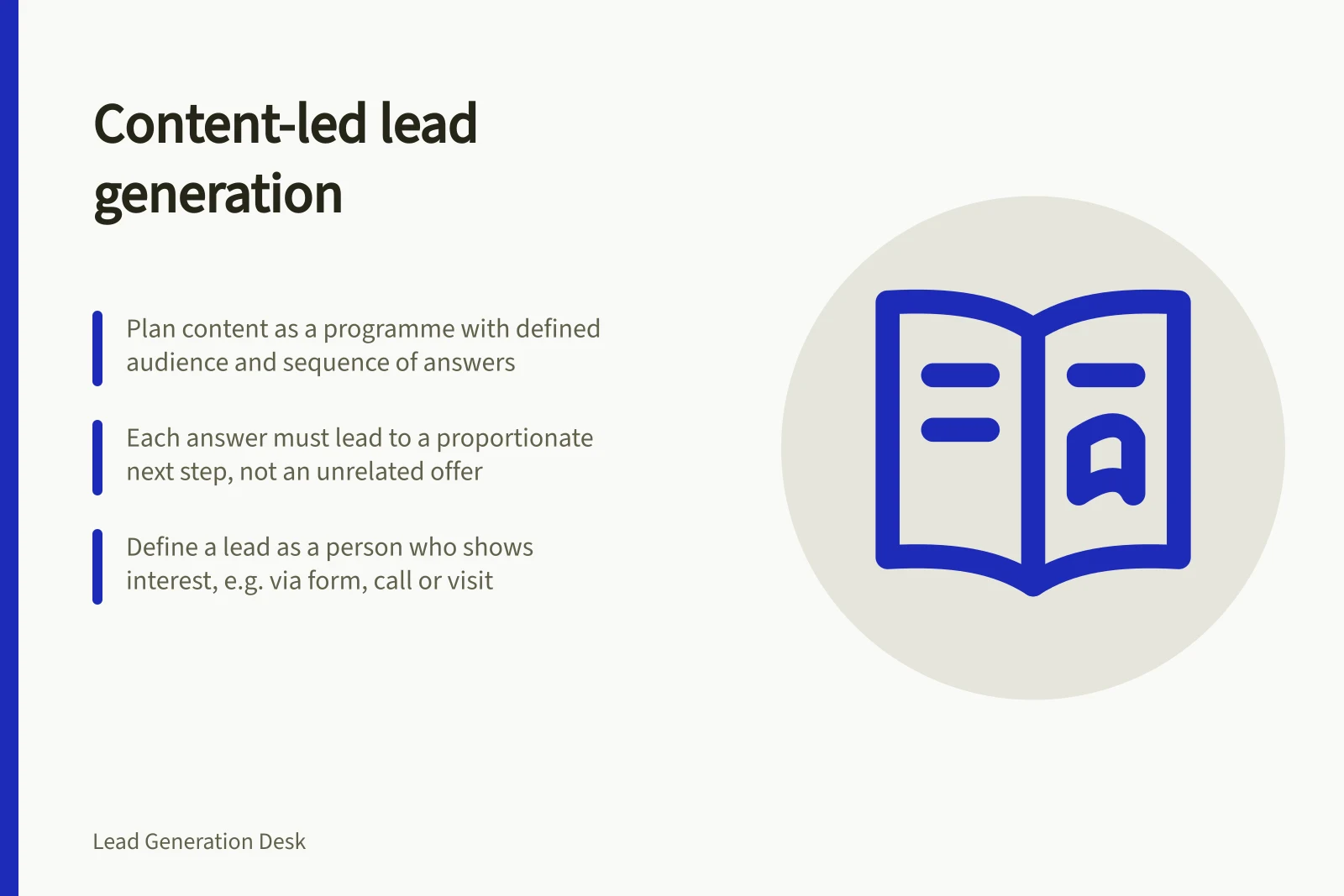
Plan content as a program with a defined audience, a role for each piece and a sequence of useful answers, not isolated posts. For a B2B service, content can build awareness and trust, explain the value of an approach and help an interested audience move towards action.
Demand generation and lead generation serve different roles: demand generation develops awareness, trust and education, while lead generation nurtures existing interest towards action. Use both roles in the program rather than expecting lead capture alone to create demand.
Set priorities around the audience and its stage in the buying lifecycle. People are not all ready to buy at the same time, so a program should not rely on one format or one message for every reader. Use the intended audience and each piece’s role to guide subject, depth and distribution.
Define what counts as a lead before planning capture. A lead is a person who indicates interest in a company’s product or service, for example by filling out a website form, calling, visiting a business or reaching out on social media.
Build a useful content portfolio
Organise a central pillar page around a topic, then create related cluster pages that explore its subtopics. Link each cluster to the pillar and link the pillar to each cluster, giving readers a route through related material.
Choose formats that explain the subject clearly and suit how the audience will use the information. The portfolio can include educational guides, checklists, templates, case studies, articles and helpful videos, rather than relying on one format.
Sequence the work around the topic: publish the pillar, add related cluster pages, then extend the portfolio with useful guides, case studies or videos. Each piece should have a defined role in educating the audience or developing interest, rather than repeating the same explanation.
Plan how each format will be produced and reused before work begins. A video can be uploaded to YouTube or Vimeo, embedded in a blog, shared on social media and sent in an email. The same useful material then reaches an audience through several routes without a separate piece for every channel.
An interactive quiz can make the next step a useful assessment rather than another download. Typeform’s guide describes connecting a quiz to HubSpot, mapping answers to CRM fields and using HubSpot’s tracking code to see which channels generate responses. It also describes setting lead scoring in Typeform or HubSpot, depending on subscription (Typeform). Use the resulting record to support qualification and relevant follow-up.
A worked, illustrative campaign for a team selling prioritisation software could begin with an educational guide on choosing what work to prioritise, then offer a Typeform product-recommendation quiz that asks for an email address. Map quiz answers into HubSpot and use agreed qualification criteria to decide who should be invited to a conversation. Typeform describes using Logic to invite people who meet qualification criteria to schedule time with the sales team (Typeform).
Use customer reviews as a possible source of evidence where the business already has customers and suitable reviews. Reviews can influence buying decisions, and third-party review platforms such as Google can help qualified prospects find a business. Treat reviews as a distinct content input, not a substitute for answers from people with relevant expertise.
Plan production and review
Make originality and completeness explicit editorial standards. Google’s people-first guidance asks whether content offers original information, reporting, research or analysis and whether it gives a substantial, complete description of its topic. When a piece draws on other material, add substantial value instead of copying or rewriting it.
Assign subject review to someone with demonstrable knowledge of the topic, and make the basis for trust clear. Google recommends considering whether a reader can see relevant expertise, clear sourcing and background about the author or publishing site. Check factual accuracy and spelling before publication, and ensure the page title describes the content without exaggeration.
Use an independent assessment as part of quality control. Google suggests asking trusted people unaffiliated with the site to assess whether its content is helpful and reliable. Their feedback can identify gaps a production team familiar with the material may not notice.
Organise distribution around the material
Choose distribution routes that fit the content and audience, rather than treating website publication as the whole program. Routes can include blogs, YouTube or Vimeo, LinkedIn and other social media, email, search engine optimisation and Google Ads. HubSpot’s marketing statistics, citing Sprout Social (2023), report that 89% of B2B marketers use LinkedIn for lead generation and 62% say it produces leads for them effectively; treat these as reported findings, not forecasts for your campaign (HubSpot). Repurpose a useful video or guide across suitable routes while keeping its central explanation consistent.
Keep the content experience coherent wherever a piece is shared. Google’s guidance says its core ranking systems seek to reward pages that provide a good page experience, and cautions against focusing on only one or two aspects. Review the complete page and its presentation, not just the wording or the channel that brought readers to it.
Review and refine the program
Use a planned review to check whether published material remains complete, useful and well produced. Google’s self-assessment questions cover originality, depth, sourcing, expertise, factual accuracy, titles and spelling. Record what needs changing, who owns each change and when it will be reviewed.
When a topic has several useful treatments, make the additional material add value rather than repeat the same explanation. Google asks whether content provides substantial value compared with other pages in search results and whether it contains insightful analysis or information beyond the obvious. Treat a weak answer as a signal to update or consolidate the piece.
Measure lead quality and content contribution
Define the enquiry event before launch, such as a completed quiz or consultation request, and record the source and content associated with it in the CRM. Typeform’s guide describes mapping form answers into HubSpot fields, while its connected-form tracking can provide insight into which channels generate responses (Typeform). Agree with sales what qualifies as a lead and record its progress from enquiry to opportunity and customer. Use analytics and CRM records to understand which content assists conversions.
Track lead volume, lead quality and marketing-qualified leads, lead-to-customer conversion rate, customer acquisition cost and ROI. HubSpot’s 2026 marketing statistics list these among the top metrics marketers use; Genroe recommends monitoring click-through rates, conversion rates and cost per lead for LinkedIn campaigns (HubSpot; Genroe). Define each measure consistently: for example, calculate lead-to-customer conversion using leads that become customers divided by leads generated. Also report content-assisted conversions and content-influenced pipeline using recorded content interactions, without assigning one article sole credit for a later sale. Compare results with your own past campaigns, then use reader feedback and sales follow-up to choose which page to improve next.
In this guide
- Choosing buying questions that can lead to a relevant enquiryChoose buyer questions with a real decision behind them and an enquiry route that can help with that decision.
- Connecting an informational guide to a useful next stepConnect an informational guide to one specific next step that helps the reader act on what they learned.
- Avoiding unrelated lead magnets on high-intent pagesRemove lead magnets that distract from a high-intent page’s immediate buying decision.
- Measuring content contribution without claiming every later saleMeasure content-assisted enquiries and later outcomes with attribution limits clearly stated.