Lead Reporting
Part of Content-led lead generation
Measuring content contribution without claiming every later sale
Measure content-assisted enquiries and later outcomes with attribution limits clearly stated.
A buyer may read a guide, return through search, speak to a salesperson and purchase months later. Measure the guide’s recorded contribution to enquiry events, then report attribution credit separately from proof that content caused a lead or sale.
Set up the evidence chain
Choose a meaningful enquiry event, such as a completed request for a scoped consultation, and verify it fires once per real submission. Use the same event definition when comparing content.
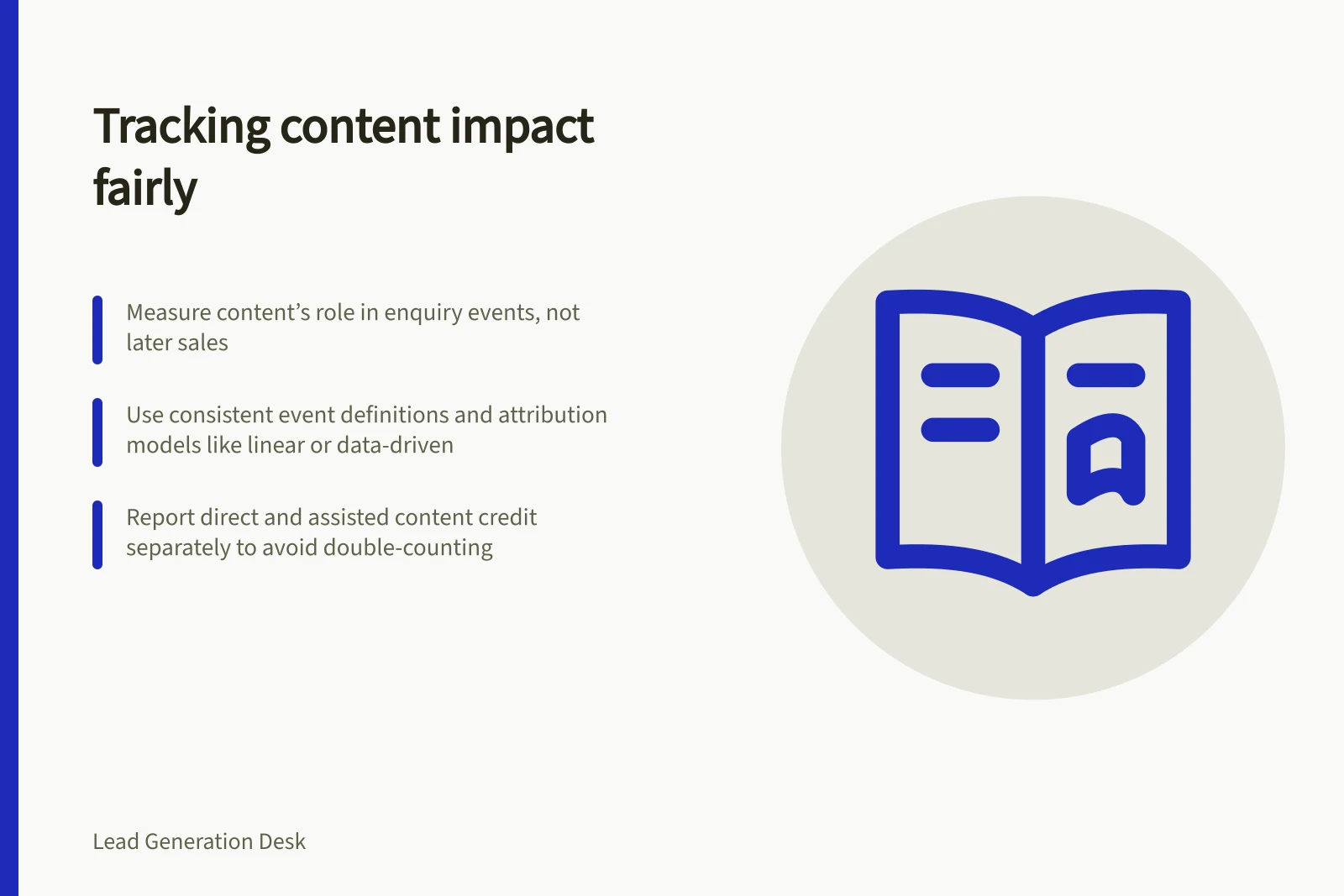
Define a direct enquiry as a key event recorded on a content page. Define an assisted enquiry as a key event with a content touch earlier in its observed path; these are different views and do not prove that content caused the enquiry.
Choose an attribution model and state it. First-touch assigns credit to the initial touch, last-touch to the final touch, linear divides credit equally across recorded touches, and data-driven uses an algorithm to distribute credit.
To calculate content-attributed lead credit, apply the chosen model to each observed lead path and add the credit assigned to content touches. With linear attribution, divide each lead event’s credit equally across its recorded touches, then sum content’s shares.
GA4 provides landing-page and key-event reports, which are different views of a journey. Record the content page, campaign and later lead status where systems and permissions allow, then match analytics to CRM records carefully.
Missing tags, consent choices, device changes, offline discussions and duplicate contacts can break the evidence chain. Keep unmatched records separate rather than assigning them content credit.
Do not turn an assisted-path count or attributed lead credit into “sales generated by this article”. A later opportunity or sale may be recorded, but that does not establish that content caused it.
Direct vs Assisted Enquiries: Understanding Content's Role
- Direct Enquiry
- Key event recorded on a content page with no prior touchpoint
- Assisted Enquiry
- Key event with a content touch earlier in the journey
Attribution Models: Credit Distribution Methods
- First-touchAssigns full credit to the initial interaction
- Last-touchAssigns full credit to the final interaction before conversion
- LinearDistributes credit equally across all touches in the path
- Data-drivenUses algorithmic analysis to assign credit based on historical patterns
Building a Reliable Evidence Chain in GA4
- Define a key enquiry event (e.g., scoped consultation request)Ensure it fires once per real submission
- Use consistent event definitions across content pagesAvoid discrepancies in tracking
- Apply attribution model to each lead pathCalculate content’s share using linear or data-driven methods
- Match analytics to CRM records carefullyHandle unmatched records without assigning false credit
Report decisions, not vanity totals
Compare qualified enquiries, opportunities and useful sales conversations by topic. Read a sample of actual requests to check whether the page answered the question and prepared the prospect.
Include a suitable baseline or comparison period when evaluating a change, and note campaigns or sales activity that also changed. Use the same event definition and attribution model for the comparison.
State the key event, attribution model, comparison period, qualified enquiry total, content-attributed lead credit and known data gaps. Report direct enquiries and assisted content credit separately rather than adding overlapping measures as if they were unique leads.
Keep observed lead status distinct from attribution credit. Use the findings to improve the answer and its next step, rather than assigning every later deal to one touchpoint.
Key Metrics for Measuring Content Contribution
- Qualified Enquiries by Topic
- Measure relevance and intent alignment
- Content-attributed Lead Credit
- Sum of credit assigned to content touches via chosen model
- Known Data Gaps
- Include missing tags, consent choices, device changes