Qualification
Part of Lead generation for professional services
Handling enquiries outside the service area
Assess out-of-area professional services enquiries, explain delivery limits and handle possible referrals with care.
When an enquiry comes from outside a professional services firm's stated area, check which limit applies to the requested work. Then tell the person whether the firm can serve them, needs to assess an exception or cannot take the project. Avoid offering a consultation for work the firm already knows it cannot undertake.
Define the boundary by service
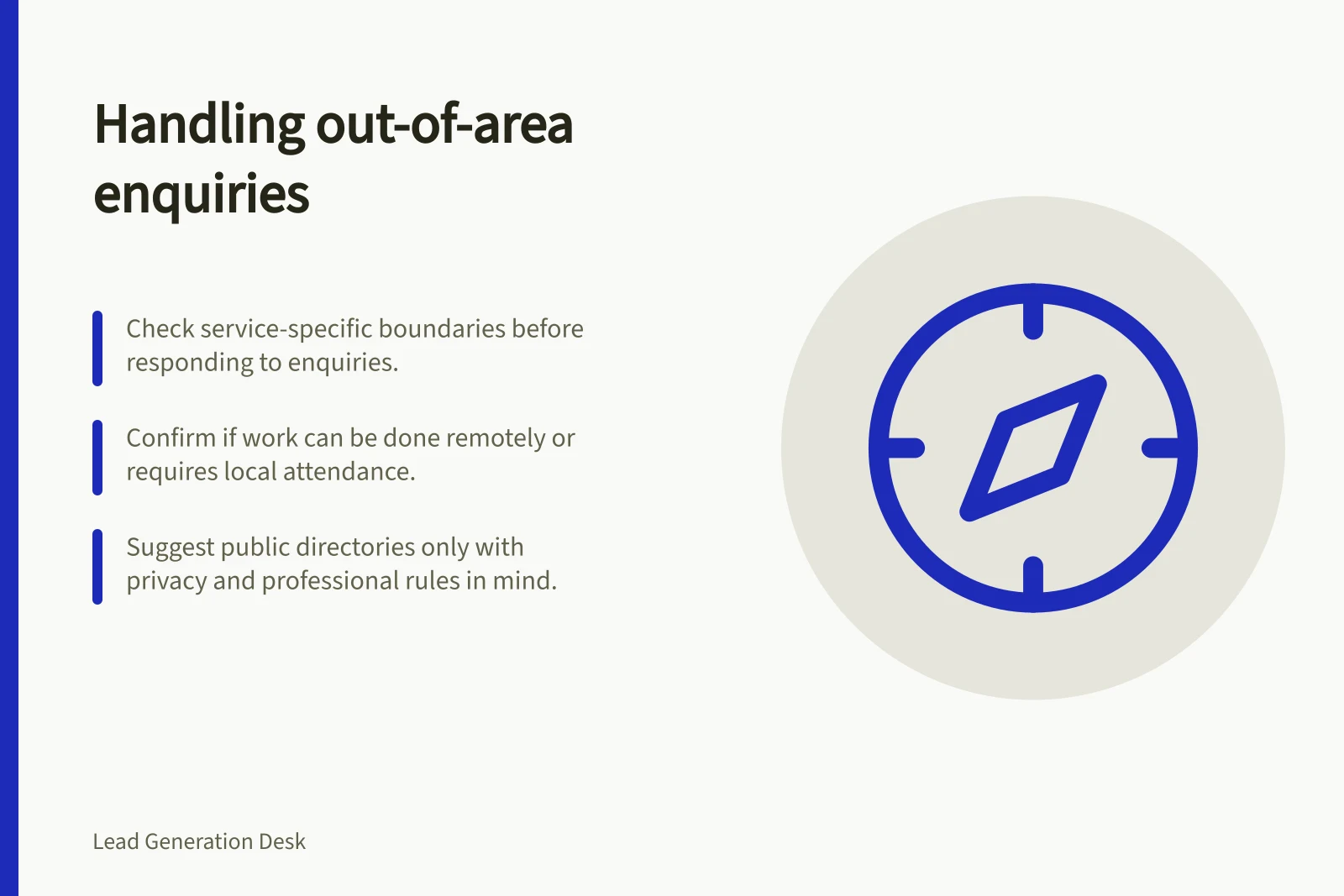
A service area may reflect travel, the need for local attendance, practitioner authority or current capacity. The limit can differ between services. Set out each service's delivery boundary and who may decide an exception before making a broad geographic promise.
Ask only for the location detail needed to decide the next step. A suburb or region may be enough for a travel check; a relevant jurisdiction may matter for specialist work. An exact address need not be requested at first contact unless it is necessary. Where professional authority determines whether work can be offered, have an appropriate practitioner confirm the position before making a commitment.
Service Area Boundaries by Service Type
- Jurisdiction-dependent work
- Restricted to areas where practitioner has legal authority; e.g., state-specific licensing requirements.
- Remote-capable services
- Can be delivered digitally; may still require local attendance for site assessments.
Give a clear response
Can serve: Confirm that the project is within scope and explain the next step. If some work can be done remotely, say which parts may still require local attendance.
Needs assessment: Explain what must be checked and when the person can expect an answer. Do not offer a confirmed service until that check is complete.
Cannot serve: State the relevant boundary briefly. Where useful, suggest a public starting point for finding a suitable professional. Do not present an unverified provider as a guaranteed fit.
For example, a hypothetical consultancy might discuss planning work remotely but undertake site assessments only within its regular travel area. Its service description should distinguish those activities instead of making an unqualified claim that it works nationally.
Handle introductions with care
Suggesting a public directory is different from forwarding a person's contact details or project documents. Ask whether the person wants an introduction and check the applicable privacy and professional obligations before sharing information.
For organisations covered by the Australian Privacy Principles, secondary disclosure of personal information is restricted unless an exception applies; consent is one possible basis, subject to its requirements. If an introduction is appropriate, explain what would be shared, with whom and why. If no suitable route is known, a clear decline is better than a speculative referral.
Improve the service description
Record the requested service, broad location and reason the firm could not proceed. Repeated out-of-area requests may show that a delivery limit needs to appear closer to the enquiry action. If the firm can genuinely deliver part of a service remotely, explain that route. The aim is an accurate promise and a useful answer without collecting more detail than the decision needs.