Inbound Capture
Part of Lead capture forms
Comparing short forms with progressive information collection
Compare short, multi-step and progressive enquiry forms by when each detail is needed, what visitors must do and what the receiving team can handle.
Use a short form when a few details answer the visitor's immediate request. Ask for more information later, once it matters to another step or a developing relationship. Neither approach guarantees better enquiries. The choice depends on when each answer is needed and what the receiving team can do without it.
Compare when the work happens
| Approach | What the visitor sees | Useful when | Main risk to check |
|---|---|---|---|
| Short first form | Details needed for the immediate request | A reply, download or initial discussion needs limited context | The team may need to ask for clarification |
| Several steps in one session | Questions divided into logical stages | The immediate task genuinely requires more information | The total effort may be unclear at the start |
| Collection across interactions | Further questions on a later visit or after an initial response | New details become necessary for a later task | The system may ask again for information already given |
A multi-step form differs from collection across interactions. Splitting a long form into screens does not reduce the total information requested. Asking later changes the timing, and the person should have a reason to provide the new detail then.
Choose from the promise
For a request to discuss a service, an email address and a concise description may be enough for a useful first reply. If the business must establish whether a site visit is possible, a broad location could be necessary at that stage. A detailed specification may be appropriate only once the team agrees to assess the project.
Map each question to the first point its answer changes a decision. If you need the answer to fulfil the original promise, leaving it out of the first form shifts work into a later exchange. If you need it only for a proposal, asking at first contact creates effort before the person knows whether the service fits.
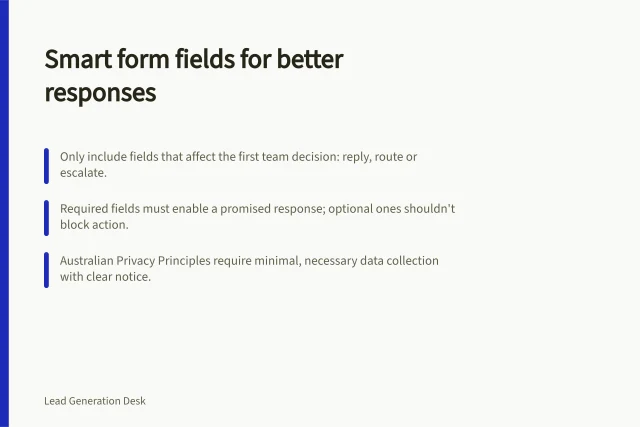
For organisations covered by the Australian Privacy Principles, APP 3's applicable necessity test applies whenever solicited personal information is collected. The OAIC advises proportionate, minimal collection.
APP 5 requires reasonable steps to notify people of specified collection matters or ensure awareness. Deferring a question does not remove those obligations when it is eventually asked.
Australian Privacy Principles (APP) guidance on information collection
- APP 3 – Necessity and ProportionalityCollect only what is necessary and proportionate to the purpose
- APP 5 – Notification of CollectionReasonable steps must be taken to inform individuals about how their data will be used
- Deferral does not remove obligationsEven if collected later, notification requirements still apply when personal information is gathered
Make a later request understandable
Explain why the new detail is needed and what the person will receive in return. Let them correct information they supplied earlier.
Do not assume a returning browser identifies the same person or that a saved answer is current. The form should remain understandable if recognition fails.
Software features can narrow the choice. HubSpot documents progressive fields for legacy forms on Marketing Hub, Service Hub and Content Hub Professional or Enterprise subscriptions. Its updated form editor does not support that feature.
HubSpot also says progressive fields cannot be used when its “Always create contacts for new email address” option is on. These limits concern that feature; a team can still ask for further information during a later conversation.
If the immediate task needs several screens, W3C guidance recommends grouping controls logically, stating the number of steps where possible and showing progress. Where possible, let people revisit earlier answers without losing what they entered.
Decide using real requests
Define what a usable first request looks like and which missing details the team can reasonably obtain later. Review completed requests, clarification exchanges and cases that stalled.
Check whether people understood the effort before starting and whether later questions arrived when they were useful. Form completion alone cannot settle which approach works better.