Qualification
Part of Lead generation for professional services
Qualifying service enquiries by actual project need
Assess professional services enquiries through the work requested, project stage, timing and delivery boundaries before booking a consultation.
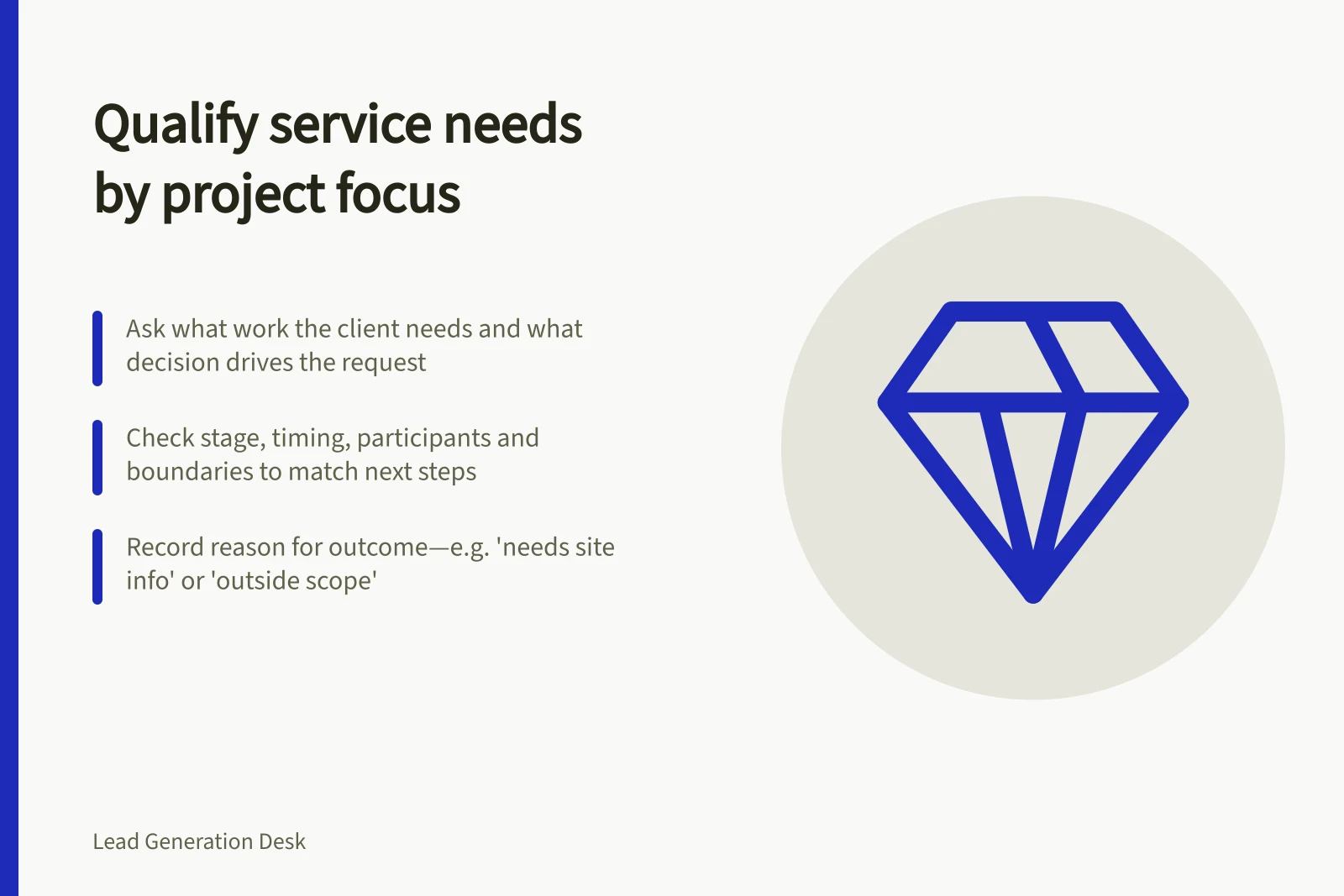
Qualify a professional services enquiry by finding out what work the person needs, what prompted the request and what decision comes next.
An industry match or a well-known organisation offers context, but neither proves the firm can help with the project.
Identify the request
Is the person asking a general question, seeking a defined deliverable, considering an ongoing service or trying to work out what problem to solve? Each calls for a different response.
If the message is vague, ask one focused question about the work rather than guessing from the sender's job title.
For example: “What decision has led you to seek help, and what would you need from us to move forward?” The answer may show that a brief explanation is enough, that a discovery discussion is needed or that the work falls outside the firm's scope.
Check what changes the decision
| Dimension | What to establish | Possible next action |
|---|---|---|
| Work requested | The task or decision the client needs help with | Match it to a service or clarify it |
| Stage | Whether the work is exploratory, planned or under way | Offer the appropriate discussion |
| Timing | Any deadline and what drives it | Check capacity before promising a meeting |
| Participants | Who can explain the need and approve a next step | Invite the relevant people |
| Boundaries | Location, specialist scope or delivery constraints | Confirm fit or explain the limit |
These are prompts for judgement, not a numerical score. An early-stage request may fit a scoping service. A person ready to proceed may still need work the firm cannot undertake.
Choose a useful next step
Book a consultation when there is a clear question for it to answer. If one missing detail would settle the route, ask for it first. If only a practitioner can assess the scope, offer a bounded discovery conversation and explain its purpose.
Consider a hypothetical design consultancy. “We need a new building” leaves the assignment unclear. “We need to assess options for adapting an existing site before a lease decision” gives the firm a decision and a useful starting point. Neither message establishes that the firm should accept the work.
Record a brief reason for the outcome, such as “needs site information”, “outside current service” or “ready for scoping”. This helps the next person respond consistently and shows whether the firm's service descriptions are attracting appropriate enquiries.
Request proportionate information
A general enquiry form rarely needs a confidential history or a large document bundle simply to decide the next step. Request the context needed for triage and arrange an appropriate way to receive more information if the project proceeds.
For firms covered by the Australian Privacy Principles, collection of solicited personal information must be reasonably necessary for their functions or activities; sensitive information has additional conditions.
Qualification should produce a useful response for the person, including a clear decline when the firm cannot help.
Pros and Cons of Requesting Detailed Information Early
- ProsHelps quickly determine fit; reduces wasted time; supports privacy compliance under APP 3
- ConsMay deter clients if too much is asked upfront; risks collecting unnecessary personal information