Funnel Experiments
Lead generation experiments
Plan lead generation experiments around a clear change, useful enquiries and a decision rule. Judge results without mistaking more clicks for better leads.
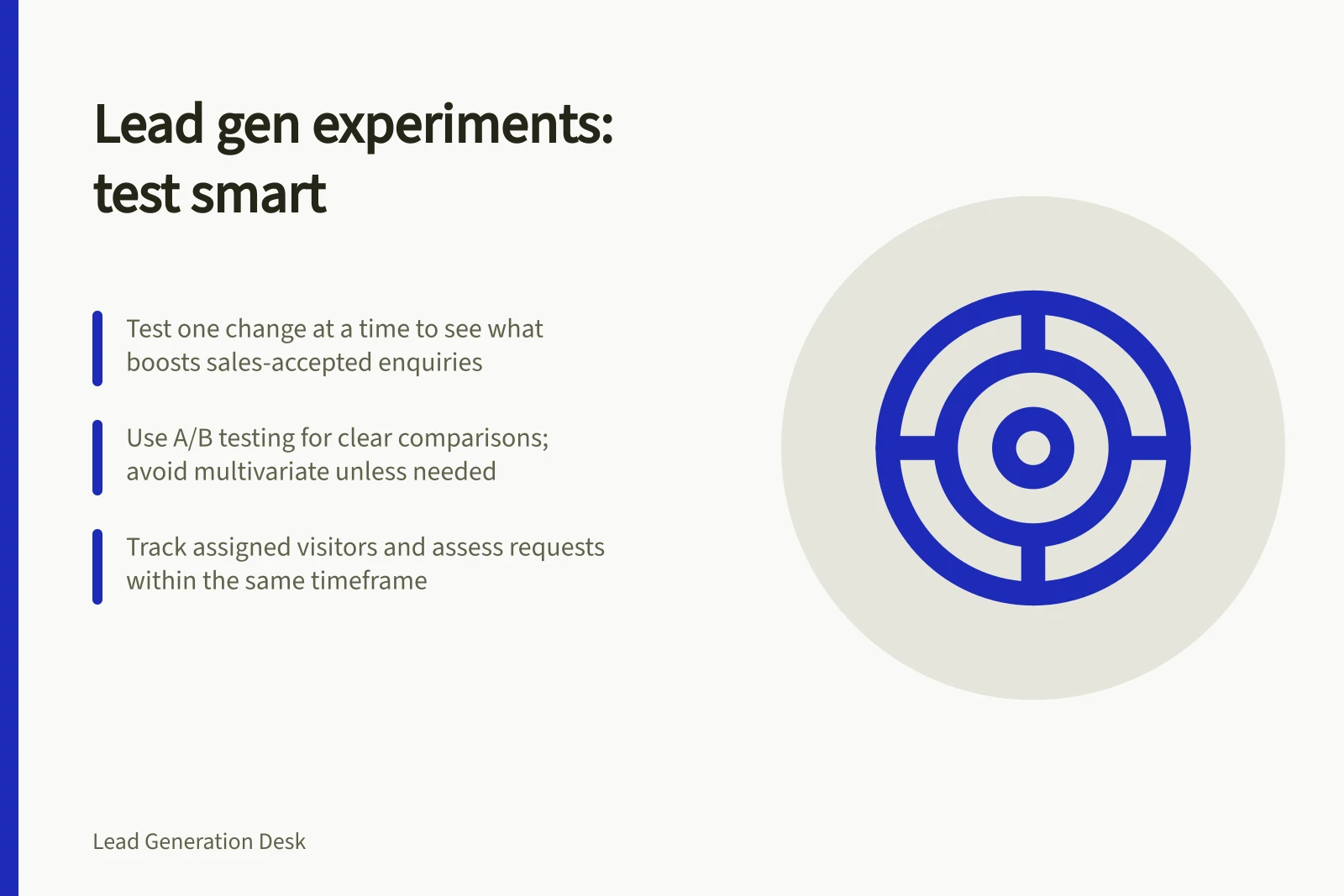
A lead generation experiment tests whether one defined change produces more useful enquiries than the current approach. Decide what you will change, who will see each version and what outcome would justify keeping it. More clicks or submissions are not enough if the resulting requests do not suit the work your team can do.
Start with a decision
Write a question you can answer. For example, ask: “Will an offer to review project requirements produce more sales-accepted enquiries than an invitation to book a general call?” A question about making a page “better” does not identify the change or the outcome.
Choose the part of the journey you need to test. An offer test compares the help promised. A form-length test weighs completion against the usefulness of the details received.
A call-to-action test checks whether different wording leads suitable visitors to the same offered next step. Record the audience, variants, primary outcome, assessment rule and planned stopping point before launch.
Make the comparison interpretable
Where a suitable setup exists, assign eligible visitors to versions concurrently and keep a returning visitor’s experience consistent. Before-and-after results are harder to interpret when demand, campaigns or staffing change between periods. Record the assignment method and confirm that each version displays and sends completed requests as intended.
Keep other parts of the journey steady where practical. If the offer changes, record the wording needed to explain it. If the form changes, keep the offer and response process consistent. Document unavoidable changes during the test; they may limit what the result can answer.
Choose the experiment shape
A/B testing compares two or more variations of a change. Multivariate testing changes more than one element at a time so you can examine the impact of each change and possible interactions between them. For example, changing both an offer and its presentation can make it harder to tell which change influenced the result.
For a decision about one part of the offer-to-enquiry journey, a focused comparison is usually easier to interpret. Use a multivariate approach only when the question includes how changes may work together and you can distinguish their effects in the results; otherwise, keep the comparison focused enough to answer the decision you recorded.
A/B vs. multivariate testing: when to use which
- A/B testingCompare two variations of one element (e.g., CTA text). Easier to interpret results.
- Multivariate testingTest multiple changes simultaneously (e.g., offer + layout). Useful only if interactions matter and effects can be isolated.
Account for search visibility
If the test uses separate URLs, do not show Googlebot a different set of URLs from those shown to people. Google Search Central warns against cloaking: showing one set of URLs to Googlebot and a different set to people violates its spam policies, even during a test, and can lead to demotion or removal from search results.
A test can use separate variation URLs, with visitors redirected from the original URL, or it can change content dynamically without changing the URL. Google notes that small changes such as button text, size, colour or placement often have little or no effect on a page’s search snippet or ranking. If Google crawls and indexes experiment content, it will probably index the eventual updates fairly quickly after the test ends.
Pros and cons of using separate URLs in experiments
- ProsEasier to manage and track different versions; useful for large-scale tests
- ConsRisk of cloaking if Googlebot sees different URLs than users; may trigger search penalties
Follow requests through assessment
For a visitor-level website test, one possible primary measure is assigned eligible visitors who make at least one sales-accepted enquiry ÷ eligible visitors assigned to that version. Use the same acceptance rule and allow comparable time for both groups’ requests to be assessed. Show pending cases separately.
Clicks, successful submissions and genuine enquiries help explain the result, but answer different questions. Keep a request record linked to its variant where the setup permits.
Key metrics for evaluating lead quality
- Primary measure
- Sales-accepted enquiries ÷ eligible visitors assigned
- Supporting metrics
- Clicks, successful submissions, genuine enquiries
- Assessment window
- Allow comparable time for all requests to be assessed
Decide what the evidence supports
Before launch, assess whether expected traffic and accepted-enquiry volume could reveal a difference large enough to matter. Choose an analysis and stopping rule suited to the assignment unit and outcome. At review, inspect group allocation, missing or pending requests and uncertainty alongside the observed difference.
Adopt a variant when the planned outcome supports it and the requests remain suitable. Retain the current approach if the variant performs worse on a decision-relevant outcome. Otherwise, state why the result is inconclusive and what would resolve the question. The accompanying guides cover offer, form and call-to-action comparisons, then the checks needed when a landing-page result is uncertain.
Plan for a difference worth detecting
A sample-size plan starts with the smallest change in the outcome that would matter to the decision. For a proportion outcome, such as the share of assigned visitors who make a sales-accepted enquiry, define the baseline proportion, the target proportion and the difference you want to detect. A change too small to alter the decision does not need to drive the test plan.
For a proportion outcome, minimum sample size can be calculated from the detectable change, a significance level and statistical power, using a normal approximation to the binomial distribution. Choose the analysis assumptions before launch; if expected eligible traffic cannot reach the required sample, recognise that the experiment may not resolve the question.
In this guide
- Testing an offer before changing page designCompare two lead-generation offers while holding page design steady. Check whether the new promise attracts requests your team can handle.
- Comparing form length with lead qualityTest short and long enquiry forms using completed requests, accepted enquiries and the effort needed to respond. Keep the denominators clear.
- Measuring whether a new call to action attracts the right prospectsJudge a new call to action by completed, suitable enquiries as well as clicks. Keep the offer stable and check what visitors requested.
- Deciding when a landing-page result is inconclusiveCheck assignment, lead outcomes and uncertainty before declaring a landing-page winner. Learn what an inconclusive result permits you to decide.