Lead Magnets
Part of Lead magnets and useful downloads
Building a practical checklist from a buyer's task
Turn a buyer’s decision into clear checklist actions, useful answer fields and a review process that exposes unresolved questions.
Build a buyer checklist from the decision the person needs to make. Turn each necessary action into a check they can complete. Each item should state what to inspect, where to record the answer and what to do if the answer remains uncertain.
Start at the decision, then work backwards
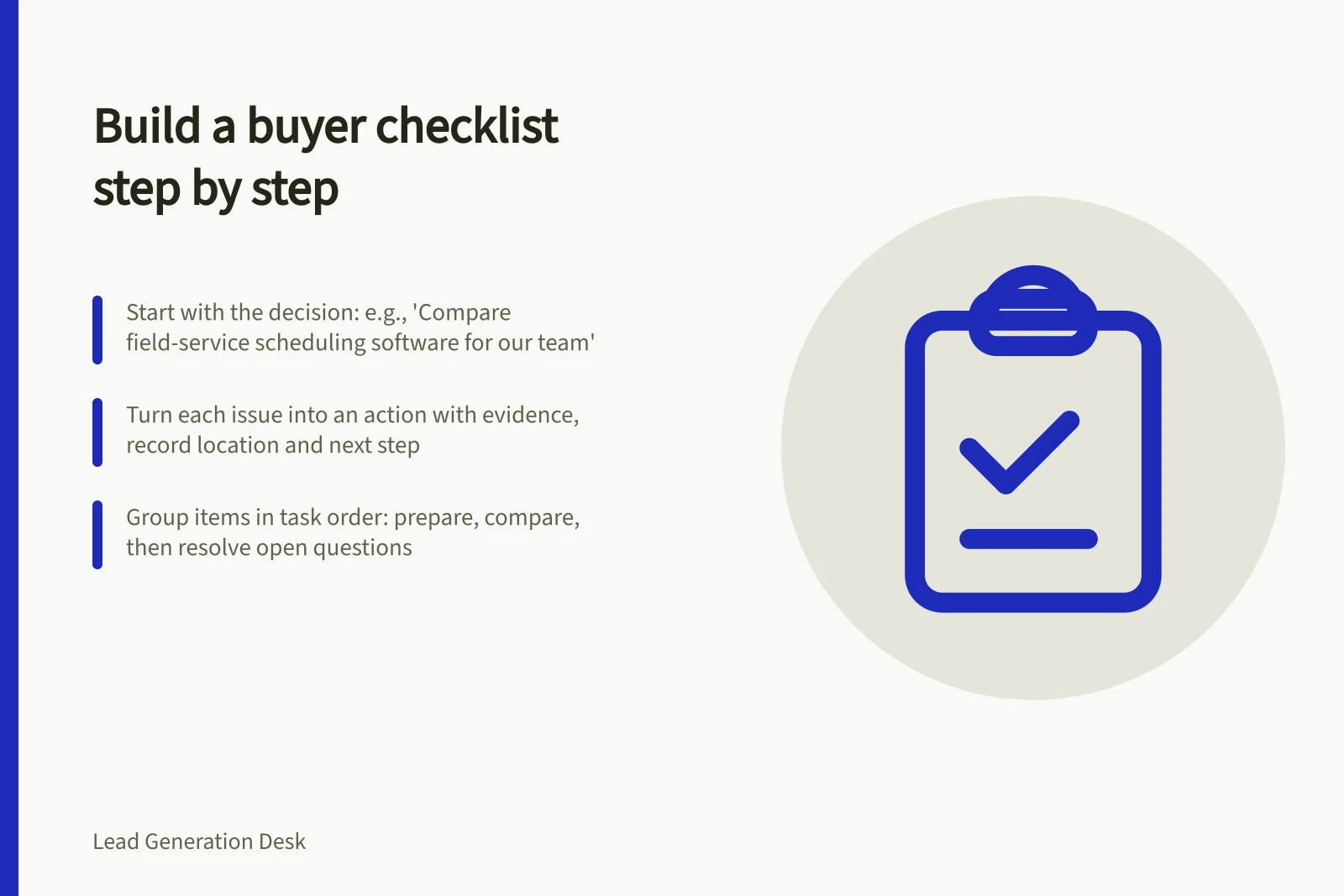
Write the task and its completion point before writing items. “Compare field-service scheduling software for our team” is more useful than “consider software”.
The buyer may need to document current booking problems, identify who uses the system and compare how shortlisted options handle essential workflows. A checklist alone may not settle the choice.
Ask the people who answer buyer questions what information is repeatedly missing. Keep checks the intended reader can reasonably perform at this stage. Mark anything requiring specialist assessment as a question for later review.
Turn each issue into an action
A useful item contains an action, a place to record evidence and a next step:
- Vague:“Check integrations.”
- Usable:“List the systems that must exchange booking or customer details. For each shortlisted option, record whether the supplier has shown how that exchange would work in your setup; mark unanswered cases for technical review.”
The second item does not promise that an integration exists or will work. It shows the buyer what still needs verification.
For the hypothetical scheduling task, a compact checklist could ask the reader to:
- Describe the booking problems the change should solve, using examples from current work.
- List the people who create, change and receive bookings, including anyone who approves exceptions.
- Choose a few common and difficult booking scenarios to show each supplier.
- Record the systems and information those scenarios depend on.
- Note any access, reporting or handover requirement that could rule out an option.
- Record each shortlisted option’s answer and supporting evidence; mark unknowns rather than guessing.
- Name the person who will resolve each open question before a final decision.
These prompts prepare a comparison. They do not establish whether any particular software fits.
Essential Steps for Australian Home Buyers: A Practical Checklist
- Describe current property booking or purchase problems using real examples from your experience.
- List all people involved in creating, changing or approving property bookings (including agents, conveyancers, lenders).
- Identify key scenarios such as offer acceptance, settlement delays, or inspection issues that may affect the purchase.
- Record systems and data dependencies (e.g., lender approval, title search, building inspection reports).
- Note any access, reporting or handover requirements (e.g., ATO GST compliance, ABN verification).
- For each shortlisted option, record supplier responses and supporting evidence; mark unknowns clearly.
- Assign a responsible person to resolve each open question before final decision-making.
Give the reader a way to use the answers
Group items in the order the task happens: prepare, compare, then resolve open questions. Provide response choices such as “confirmed”, “needs checking” and “not applicable”, with space for a note.
Define what “confirmed” means. Where supplier evidence is needed, distinguish it from the buyer’s assumption.
Keep the checklist within the decisions it can support. An unanswered item may prompt a supplier question; it does not automatically disqualify an option. Put a material limit beside the relevant item so the reader does not mistake a preparation tool for a final assessment.
Step-by-Step Home Buying Process for First-Time Buyers in Australia
- PrepareAssess finances, get pre-approved by a lender, and check your credit history.
- CompareEvaluate properties based on location, price, condition, and future resale potential.
- Resolve Open QuestionsAddress concerns about building inspections, strata fees, or council approvals.
- FinaliseSign contracts, arrange settlement via a solicitor or conveyancer, and register ownership with the state land registry.
Review it as a working document
Ask a subject specialist to check the sequence and an intended user to try completing the task. Look for items that require information the reader cannot obtain, duplicate another check or produce an answer nobody uses. Revise the wording, order or promised outcome accordingly.
A practical checklist lets the buyer finish a task, see what remains uncertain and bring a better question to the next conversation.