Inbound Capture
Part of B2B website conversion paths
Reducing friction between a service page and a contact form
A service page can persuade a visitor and still lose the enquiry when the next step opens a generic form with no context.
A service page can persuade a visitor yet lose the enquiry if the next step opens a generic form without context.
Carry forward the intent
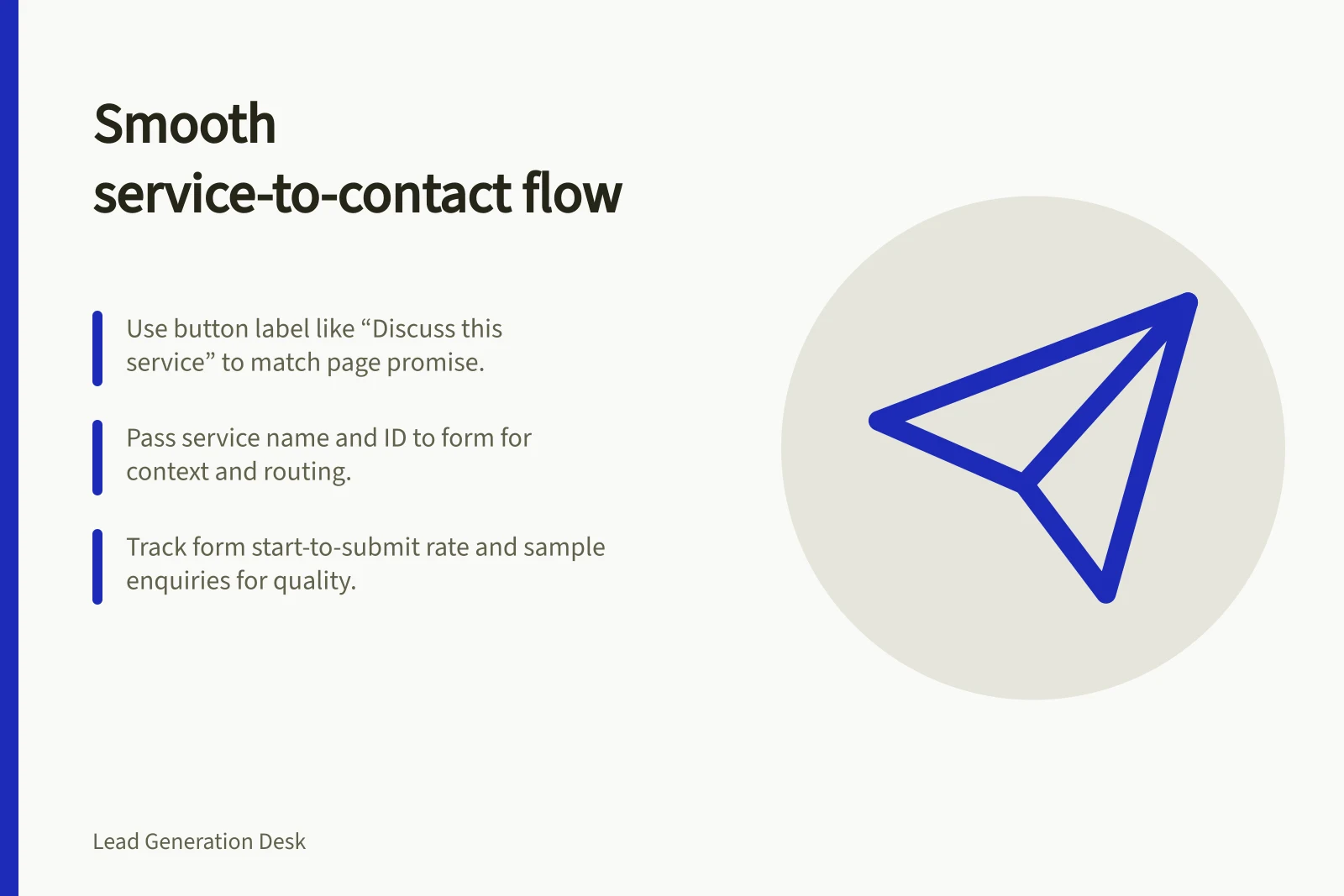
Use a button label that matches the page promise, such as “Discuss this service”. On the form, repeat the service name and explain what happens after submission. Pass the page or service identifier into the internal record if the system allows, while leaving the visitor room to describe a different need. Do not ask them to restate facts the page already established.
Keep only fields needed for routing and a useful first response. W3C guidance supports associated labels and clear instructions; test required-field errors and keyboard navigation as well as mobile layout. If the visitor leaves the form, review whether the issue is an unclear offer, a long form or a technical failure before removing fields.
Optimising the service page to contact form handoff
- Use a context-aware button labele.g., ‘Discuss this service’ instead of ‘Contact us’
- Repeat the service name on the formEnsure continuity and clarity for the visitor
- Pass service identifier to internal systemsWhere supported, route enquiries accurately using page context
- Minimise form fields to essentialsOnly collect data needed for routing and initial response
- Test accessibility and usabilityValidate labels, error messages, keyboard navigation and mobile layout
Pros and cons of retaining context in form design
- ProsReduces cognitive load, improves conversion, supports accurate routing, enhances user trust
- ConsRisk of over-restriction if form assumes too much; may limit flexibility for new needs
Measure the handoff
Track service-page visits, form views, starts and submissions where your analytics setup supports it. Compare the service-page-to-form rate and form-start-to-submit rate, then sample the resulting enquiries for quality. Test confirmation and internal notification on each route. A completed form that goes to the wrong team is still a broken conversion path.
Key conversion metrics to track
- Service-page to form view rate
- Track percentage of visitors who move from service page to form
- Form start to submission rate
- Measure completion rate from form initiation to submission
- Enquiry quality (sampled)
- Review a subset of submissions for relevance and completeness