Inbound Capture
Part of Lead generation landing pages
Writing an enquiry page without vague business promises
Replace vague claims with service scope, a precise enquiry invitation and an honest explanation of the first response.
Write an enquiry page around what a prospective customer can ask, what the business can assess and what response follows. Replace “tailored solutions” with a service scope and a next step the team can deliver. Put any limit that changes the visitor’s decision beside the promise.
Turn a slogan into an answer
“Expert support for every business” does not say what work is available or how an enquiry will be handled. A useful opening names the situation and the response. For a hypothetical equipment-inspection business, it might read:
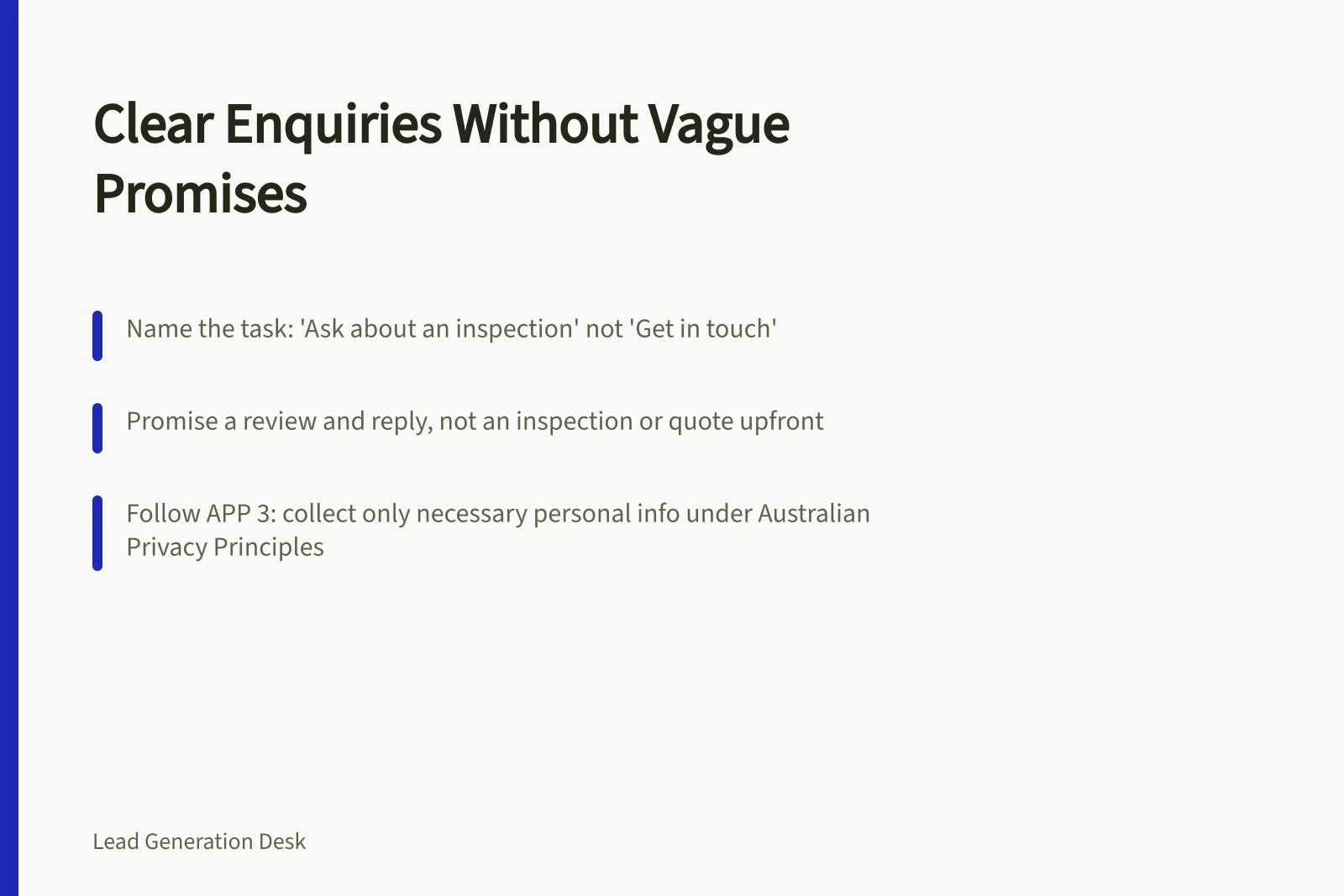
Tell us about the equipment you need inspected and the site where it is used. We’ll review the request and let you know whether an inspection is within our service scope.
That wording promises a review and reply. It does not promise an inspection, quote or outcome before the details are known.
Draft the core copy in this order:
- Need:the problem or decision the page addresses.
- Scope:what the business can consider, including a material limit.
- Request:what the visitor should send or ask.
- Response:what the team will do next.
A claim such as “national coverage”, “same-day response” or “fixed price” needs to be true for the circumstances described. If it is not, explain the actual service area, response process or factors affecting price.
Use proof with its limits intact
A case example can show the kind of work undertaken when its details are accurate and the business has permission to use them. Say what was done and which conditions mattered. Use a testimonial only if it is genuine and its use is authorised. Neither should imply that another customer will get the same result.
If suitable proof is unavailable, explain the service process. What does the first review establish? What will need a later conversation?
Make the invitation precise
“Get in touch” may work as navigation, but the main invitation should name the task: “Ask about an inspection” or “Send your project details for review”. Say whether submission requests a reply, a call to clarify details or a confirmed booking. Match the confirmation message to what actually happened.
Keep any form request consistent with that promise. Ask for details needed for the first response, label fields plainly and explain how the information will be used.
For an organisation covered by the Australian Privacy Principles, APP 3 limits collection of non-sensitive personal information to what is reasonably necessary for its functions or activities; sensitive information has additional rules. Check the obligations that apply to the business and form.
Check the promise with the receiving team
Read the heading, service claims, action and confirmation message together with the people who handle enquiries. Remove a claim they cannot reliably deliver. Add a missing limit if it would change a visitor’s decision. Later, use repeated misunderstandings in actual enquiries to identify wording that needs clarification.
Key compliance and performance facts
- APP 3 – Information collection limit
- Only collect personal information reasonably necessary for functions or activities
- Consumer Data Right (CDR) coverage
- Applies to businesses with annual turnover over $10 million
- WAI-ARIA forms guidance
- Ensure form labels and instructions are accessible for screen readers